
Land development always begins with one key step: understanding the land. Builders, engineers, and property owners need clear information before they start a project. Today, drone surveying is changing how that information is collected.
Even more exciting, new research in Rochester shows that aerial technology may soon make land mapping faster and smarter.
Drones already help surveyors collect data from above. Now new tools combine drones with sensors and artificial intelligence. Because of this progress, drone surveying does more than take pictures. It also helps professionals understand land conditions.
A New Step Forward for Drone Surveying
Over the past ten years, drones have become common tools in mapping and construction planning. Survey teams fly drones over a site. They collect aerial images from above. Then special software turns those images into maps and terrain models. This gives project teams a clearer view of the land before planning begins, which is why many developers now rely on aerial mapping for land development projects when they need to study a property.
Recently, researchers in Rochester began testing new ways to improve this process. They used drones with advanced sensors and artificial intelligence. These tools help study ground data much faster.
Instead of only taking pictures, the system studies patterns in the terrain.
Because of this, drone surveying may soon give deeper insight into land conditions. This happens before design work begins. Developers and engineers can start projects with fewer surprises.
From Aerial Photos to Smart Land Data

In the early days of drone surveying, the goal was simple. A drone flew over a property. It captured many aerial images. Then software joined the images together to create maps.
This process still matters today. However, modern drone surveying now goes further.
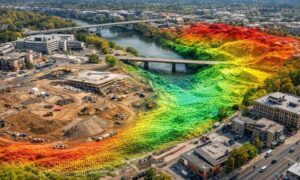
Today’s systems create digital terrain models. These models show the shape of the land. They also show slopes and surface patterns across a site.
Engineers can rotate the model. They can zoom in. They can measure features on the screen.
Better sensors now collect richer data during each flight. Because of this, surveyors can see the terrain more clearly before construction begins.
So drone surveying now focuses less on simple pictures. Instead, it focuses on useful land data.
Why the Rochester Breakthrough Matters
The recent research in Rochester shows an important change in mapping technology. In the past, drones mainly worked as flying cameras.
Now engineers combine drones with smart analysis tools.
In this research, drones collect information from several sensors while flying across an area. Artificial intelligence then studies patterns in the data.
This process helps identify features on the ground much faster.
For land mapping, this brings several benefits.
First, teams can study large areas more quickly. Second, software can highlight terrain features that may affect construction. Third, project teams gain early insight into how land conditions may affect design plans.
Because of these improvements, drone surveying may help developers make better decisions. This happens before they invest time and money into a project.
Why Better Land Mapping Helps Projects
Before construction begins, developers must answer many questions about a property.
For example, they need to understand slopes, drainage patterns, and the shape of the land.
In the past, gathering this information required several steps. Field crews collected measurements. Engineers reviewed the results later.
This method still works well. However, it can take time to study large areas.
Drone surveying helps teams see the full site earlier in the planning process.
For example, aerial mapping can show how water flows across a property. It can also reveal uneven terrain that may affect building layouts.
Because of this information, designers can adjust plans before construction begins.
Better mapping helps reduce problems later.
Projects That Benefit the Most
Many projects now use drone surveying during early planning stages.
Large properties benefit the most. Aerial mapping covers wide areas quickly.
For example, developers may use drone surveying when studying land for new subdivisions. The aerial data helps planners understand the terrain before designing roads and lots.
Infrastructure projects also benefit from this technology. Roads, utility corridors, and public improvements often stretch across large areas.
Drone mapping helps engineers view the entire corridor at once.
Commercial development teams also rely on drone surveying. They study site conditions before design work begins.
Terrain models allow teams to explore the land from different angles.
These insights help projects move forward with better information.
Why Rochester Is a Good Place for Innovation
Rochester has a strong history of technology research and engineering education.
Universities in the area explore new ways to use advanced tools in real industries.
Because of this environment, innovations in drone surveying often appear here first.
Researchers test new sensors, data systems, and mapping tools. Then these ideas spread to surveying professionals across the country.
The region also continues to see development activity. New housing and infrastructure projects require detailed land mapping.
Because of this, Rochester is a strong place to explore how drone surveying can improve land analysis.
The Future of Drone Surveying
Drone technology continues to improve quickly.
Each year, new sensors capture more detailed information during aerial flights. Software also improves at turning raw data into useful insights.
Because of these changes, drone surveying will likely play a larger role in land mapping.
Future systems may analyze terrain conditions soon after a drone flight. Engineers could review land data within hours instead of days.
This speed helps teams respond to project challenges earlier.
Improved mapping tools also help surveyors work closely with architects, engineers, and developers.
These advances help teams understand land conditions more clearly before construction begins.
A Smarter Way to Understand Land
Land mapping has always been important for successful development.
Today, drone surveying offers a new way to collect and understand land information.
Thanks to recent research in Rochester, drones now do more than capture aerial images. They also help analyze terrain and reveal patterns across large properties.
For developers, engineers, and property owners, this progress means better insight before construction begins.
With clearer land data, projects can move forward with more confidence and fewer surprises.
As technology improves, drone surveying will likely become an even more useful tool for understanding land from above.