A boundary survey is one of the most useful tools a developer or homeowner can use when dealing with driveway questions on older residential lots. Driveways seem straightforward. But on lots built decades ago, the picture gets complicated fast.
How Driveways on Older Lots Can Raise Boundary Questions
New York has thousands of homes built well before modern subdivision rules existed. In neighborhoods like Woodhaven, Flatbush, and parts of the Bronx, many residential lots were laid out in the early 1900s. Standards were different. Record-keeping was inconsistent.
Over the decades, driveways shifted. Some were widened to fit a second car. Others were repaved without anyone checking the original lot line. A few were shared between neighbors for so long that both parties assumed ownership.
None of that history tells you where the legal boundary actually sits.
That is the problem. What you can see does not always match what the records say. A driveway that looks like it belongs to one lot may cross into another. Without a boundary survey, no one knows for certain.
This matters a great deal to developers. If you are buying an older residential property and planning improvements, you need accurate boundary information before you spend a dollar on construction.
Why Old Deeds and Visible Features Do Not Always Match
Older deeds were often written using landmarks that no longer exist. A deed might reference a stone wall, a tree, or a fence that has long since been removed. When surveyors go out to locate those points today, the references may lead nowhere useful.
At the same time, visible features on the ground, including pavement edges, retaining walls, and curb cuts, were placed without formal verification in many cases. A homeowner paved a driveway where it seemed to fit. A neighbor did the same. Neither checked the recorded boundary.
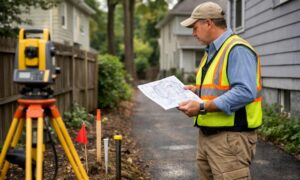
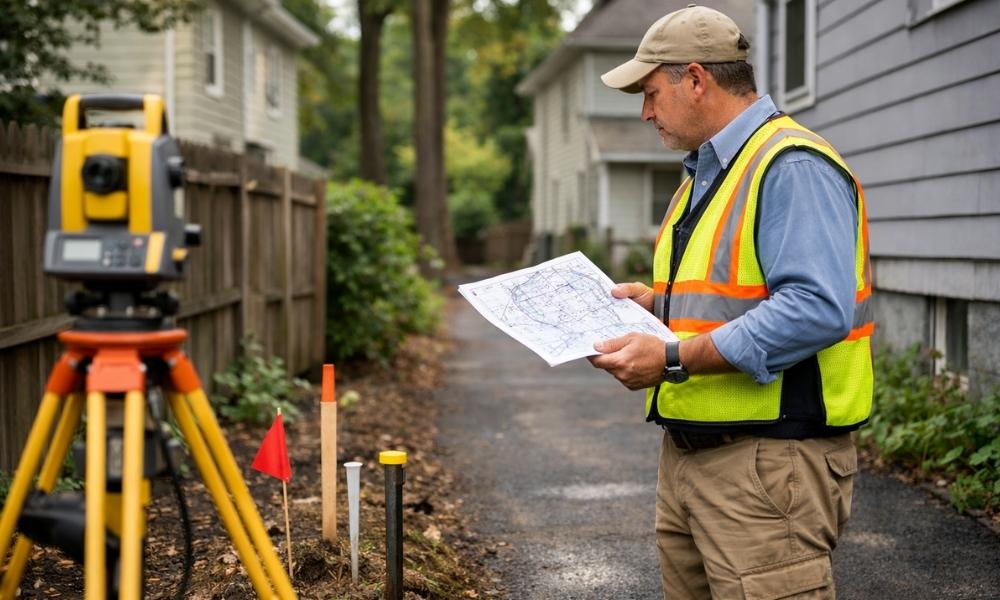
A boundary survey fixes this. It compares the legal description from the deed with precise field measurements taken on-site. The surveyor identifies the actual property corners and maps where the driveway sits in relation to those corners.
The result is a clear, documented answer. You no longer have to guess whether the driveway is fully on one lot or whether it crosses a line.
What Surveyors Look For
When working on older residential lots, a licensed surveyor will typically:
Review the original deed language and any available maps from the county or city records. Locate existing survey monuments or iron pins in the ground. Measure distances and angles from established reference points. Note where improvements like driveways, fences, and walls fall relative to the boundary.
Each of these steps builds a complete picture of where the lot line actually is.
Shared Driveways and Long-Standing Access Arrangements
Some older New York neighborhoods have shared driveways that two households have used side by side for 30, 40, or even 60 years. That history can create a false sense of clarity.
Long-term use does not automatically establish legal ownership or access rights. It may support a claim of prescriptive easement in some cases, but that is a legal determination, not a surveying one. The boundary survey does not resolve the legal question. It gives you the factual foundation to work from.
Before you make any improvements to a shared driveway, you need to know exactly where the property lines fall. A boundary survey shows you how the driveway relates to those lines. From there, you and your attorney can address any access arrangements that may need to be formalized.
Skipping this step is a common and costly mistake. Developers who assume a shared driveway arrangement is settled sometimes find out during closing that the arrangement was never properly documented.
Planning Driveway Repairs or Expansion With Confidence
In older New York neighborhoods, lots are tight. There is often very little margin between properties. A driveway expansion of two feet in the wrong direction can put you on your neighbor’s land.
If you are planning to repave, widen, add a retaining wall, or install drainage along a driveway, get a boundary survey done first. It tells you exactly how much room you have to work with.
This is not a precaution for edge cases. It is a standard step for responsible development on older urban lots. Construction crews do not verify property lines. Contractors follow the plans you give them. If your plans are based on guesses rather than survey data, the mistakes become your responsibility.
New York also has local permitting requirements that may require survey documentation before driveway work is approved. Knowing your boundary in advance keeps the permitting process moving without unnecessary delays.
How a Boundary Survey Creates a Clear Record for Future Owners
A boundary survey produces a recorded document. That document stays with the property and becomes part of its history.
For developers, this has real value. When you sell the property, the next buyer has accurate information about the driveway location. There is no ambiguity about what belongs to the lot. Title companies and lenders appreciate having that documentation in place.
It also reduces the chance of disputes after the sale. Neighboring owners who have questions about driveway placement can be pointed to the survey record rather than relying on memory or assumption.
In New York’s dense residential market, clear property records make transactions smoother. A boundary survey completed before development or sale is one of the simplest ways to protect both the buyer and the seller from future confusion.
Frequently Asked Questions
How can a boundary survey help with driveway questions?
A boundary survey shows the location of property lines and helps determine whether a driveway is fully on one lot or affects neighboring property.
Why are driveway issues common on older residential lots?
Older homes may have been built before current standards, and driveways may have changed over many decades, creating uncertainty about their location.
Can a boundary survey identify a shared driveway?
Yes. A boundary survey can show how the driveway relates to the property lines and provide information useful when reviewing access arrangements.
Should I get a boundary survey before replacing or widening a driveway?
Yes. Knowing the exact boundary can help prevent construction mistakes and avoid problems with neighboring properties.
Do old fences or pavement edges prove where the property line is?
Not always. Visible features do not necessarily match the legal boundary, which is why a boundary survey is important.